

History and Politics
Introduction
The History and Politics Department has a philosophy that combines academic rigour with a commitment to high-quality teaching and learning. At the heart of its philosophy is a commitment to an enquiry-led approach in which students analyse a wide variety of historical sources and information to answer key questions. The department uses a wide range of activities and resources, including textbook work, role-plays, group work and human timelines. A lot of work is also put into developing students’ historical skills, including historical significance, interpretation and cause and consequence.
Years 7 – 9
The overarching theme of the key stage 3 History course at Halliford is ‘The History of Britain and its relationship with the wider world’. An innovative approach combines a chronological understanding with thematic comparisons to deepen and further develop students’ historical understanding. In year 7, after an introduction to the study of history, students learn about the Norman Conquest and the medieval world. In Year 8, they continue with the Tudors and Stuarts before moving on to study the British Empire and Britain’s involvement in the Transatlantic Slave Trade. Year 9 concludes with a focus on the Twentieth Century World, examining the World Wars and the roots of conflict in the Middle East. Throughout the course, students are encouraged to make thematic comparisons, including warfare, empire, religion and individual rights, across the different historical periods, as we introduce them to the key historical concepts of causation and consequence, evidence, change and continuity, significance, interpretation and empathy.
GCSE
Four different topics are studied at GCSE. In Year 10, students start the course with a development study, Medicine and Medicine in Britain c1250-present day. Students study key aspects of medicine through four different periods: the Middle Ages, the Renaissance, Industrial Britain and the Twentieth Century. This is followed by a deep study of Weimar and Nazi Germany, including Germany in the 1920s, the rise of Hitler and the Nazi Party, and life in Germany under the Nazis from 1933 to 1939. In year 11, the topics of Elizabethan England and the Cold War complete the course.
A Level
The expansive approach towards History continues at A Level. The department uses OCR as its exam board because of the range and combination of different topics available. In Lower Sixth, the Early Tudors and Tsarist and revolutionary Russia are taught, and this is complemented with a more modern course in Upper Sixth on Civil Rights in the USA 1865-1992. In Upper Sixth, students also complete an extended coursework essay on a topic of their choice, about 4,000 words in length.
The department also offers A Level politics. We follow the Edexcel exam board, which includes three key components: UK Politics and Government, Political Ideologies and Comparative Politics (USA). The Ideologies course examines the roots and core principles of liberalism, conservatism, socialism and feminism, as well as the ideas of key thinkers of these ideologies. In the UK and US papers, we examine democracy and participation, political parties, electoral systems, voting behaviour and the workings of the legislature, judiciary and executive branches of both countries.
Tours and Trips
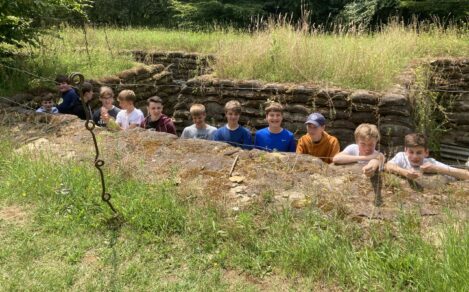
The Department has traditionally always sought to provide a variety of day and residential trips to support and enhance learning. The Department organises an annual trip for all Year 9 students to the World War One battlefield sites of Ypres. We also run a bi-annual trip to Berlin for GCSE students as part of their studies on the Cold War and Weimar and Nazi Germany. Closer to home, Year 8 visit Hampton Court Palace as part of their study of the Tudors, and our Sixth Form students are organised visits to academic lectures, the National Archives, the Supreme Court and Parliament.






0 CommentsComment on Facebook